Work 01 AI product MVPs
Atlas
A personal operating system: tasks, projects, habits, weekly commitments, mail and calendar in one place, with an AI agent that can act on it only through a narrow, audited set of tools.
01 The problem
Personal admin lives in a dozen places: an inbox, a calendar, a to-do app, a habit tracker, notes, a fitness app. None of them knows what the others say, and an AI assistant that could connect them usually gets far more access than it should.
Atlas pulls those into one workspace for one person, measures whether weekly promises are kept, and lets an agent help without handing it the keys to everything.
02 My role
Sole developer across 13 documented build phases, from the first task list to the Command Center.
03 Architecture
Atlas is a Next.js app on MongoDB that runs on the owner's own machine. Sign-in is Google only, restricted to an allow-list of emails. It reads and acts on Gmail (archive, read, star, email-to-task proposals) and Calendar, and connects to other services the owner runs, Recomp 88 and the health-data service, through per-user tokens.
The Command Center is the home screen: weekly commitments with a kept-rate across eight closed weeks, projects sorted by how long they've gone quiet, habits, goal pace and focus time. Commitments can count evidence automatically: gym sessions from Recomp, watch workouts, step and sleep thresholds, linked tasks or focus minutes.
AI runs through a local agent gateway, Hermes. Chat, task parsing, email summaries and digests all go through it, and the agent's only toolset is Atlas's own MCP server.
04 Two hard decisions
A
The agent gets one door
Hermes reaches Atlas only through Atlas's MCP tools: no terminal, files, web or direct Gmail access. Email and note text is passed in as delimited, untrusted data, every model response is validated with Zod, and any reported tool use in a completion is rejected.
Anything that changes your day waits for you. Tasks proposed from email sit in the Inbox until you approve them, and AI requests are capped at ten a minute per user.
B
Sources fail on their own, never together
Each connected service is read independently. If the health service is down, the Body tile still shows gym sessions, and a commitment's evidence falls back to the last good weekly snapshot, so an outage can't turn a kept week into a broken one.
Connector tokens are encrypted, bound to the user and the connector, and never sent to the browser. Settings shows only the last four characters, and data export leaves the connector collection out entirely.
05 The result
- test files
- 65
- API routes
- 70
- documented build phases
- 13
- weeks of kept-rate history
- 8
Atlas runs as a single-user system on the owner's machine, wired to real mail and calendars, so these screens come from a local copy running on an in-memory database with an invented week, and the AI gateway disconnected.

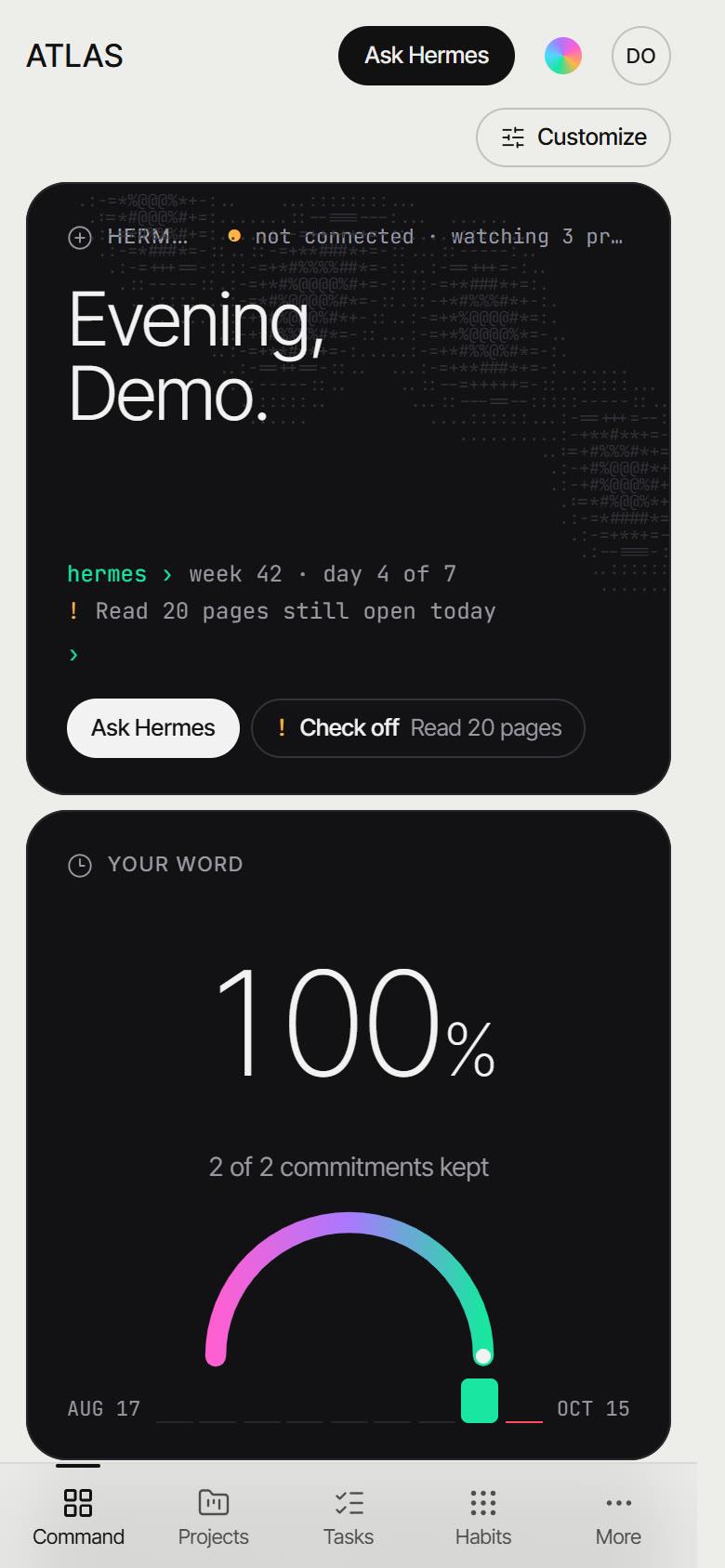
Screens show seeded demo data on local or emulated devices. No real users or records.